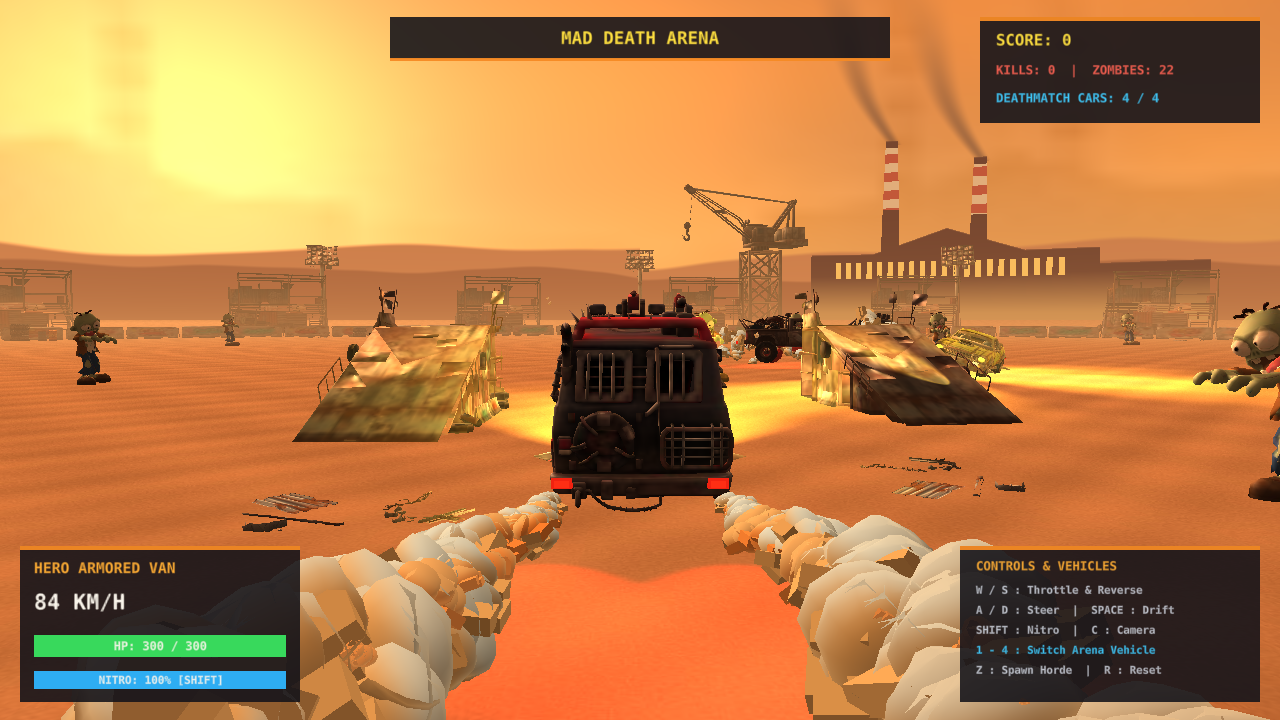
Welcome to the behind-the-scenesMad Death Arena Devlog! To celebrate Halloween this year, we set ourselves an ambitious technical and creative challenge: what happens when you fuse the post-apocalyptic vehicular chaos ofMad MaxandCarmageddonwith an unstoppable undead horde—and pack the entire 3D experience into a lightning-fast web prototype under 5 megabytes? Today, we are lifting the hood onMad Death Arenato show you how we built our Halloween prototype from the ground up, complete with custom suspension physics, 10-piece zombie dismemberment, and extreme browser optimization.
Play Mad Death Arena Right Now!
Zero downloads, zero plugins. Run the full 3D prototype free in your desktop or mobile browser.
1. The Halloween Concept: Mad Death Arena Devlog Vision
Every Halloween, we love experimenting with darker, high-adrenaline concepts. Rather than making a slow-paced survival horror game, we wantedMad Death Arenato deliver instant, visceral arcade action. You are locked inside a fortified industrial desert arena where two threats collide: heavily armored rival cars trying to ram your chassis into scrap metal, and dozens of ravenous zombies swarming from every angle.
Our core design philosophy rested on two pillars:
Wasteland Demolition Derby
High-speed ramming, powerslides, nitro boosts, and aerial stunt ramps set inside a 35x-scale post-apocalyptic colosseum surrounded by rusting cranes and smokestacks.
Swarming Undead Physics
Zombies aren’t just static bowling pins—they limp, lunge, get knocked down, climb back up, and physically cling to your vehicle’s doors if you slow down!
2. From Godot Prototype to Defold Engine: The Web Performance Leap
We started the initial prototype inGodot 4using simple geometric blocks to test whether drifting and ramming targets felt fun. The gameplay loop clicked immediately, but we hit a major roadblock when testing for instant browser play: standard 3D web exports often carry 20 to 35 MB of base engine overhead and heavy shaders that struggle on mobile browsers.
To make the prototype load in the blink of an eye on any desktop or smartphone, we made a bold engineering pivot and migrated the project toDefold Engine(powered by C++ and Lua). From there, we wrote a custom arcade vehicle physics solver from scratch:
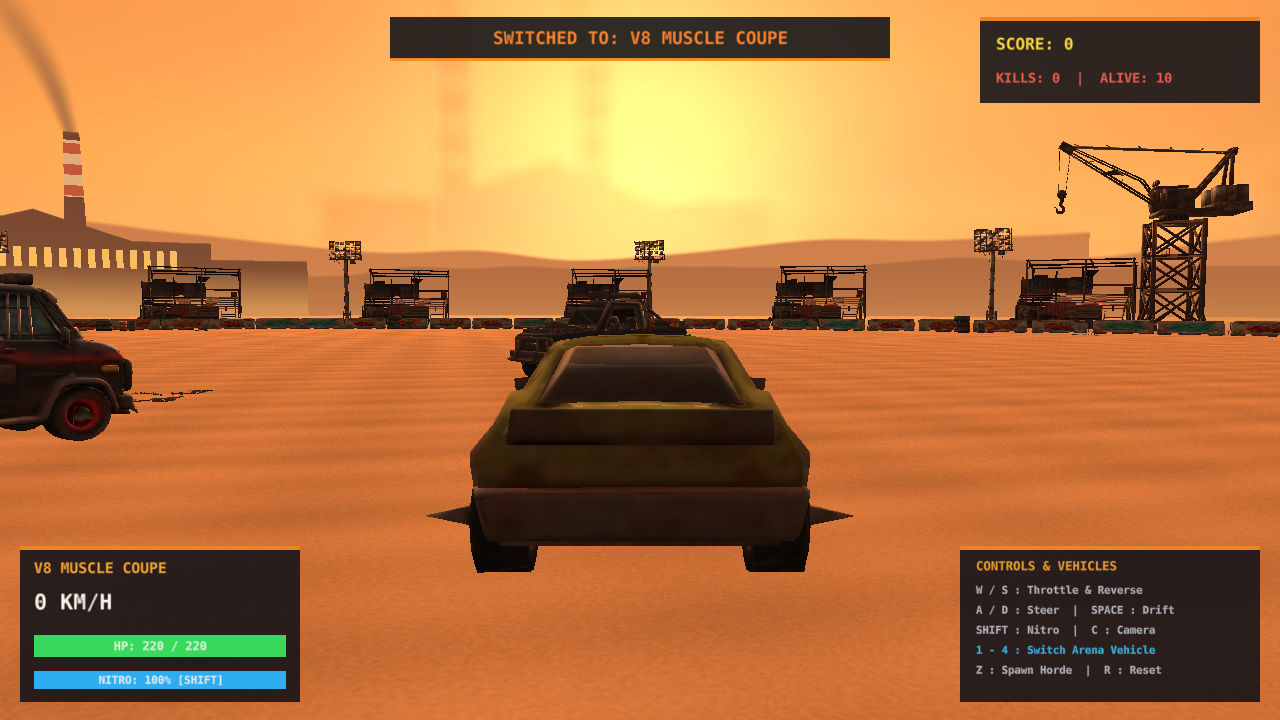
- 4 Distinct Armored Vehicles:Players can switch between the agileV8 Muscle Coupe, the tank-likeHeavy Armored PickUp, the nimbleCompact Offroad PickUp, and the balancedHero Armored Van.
- Harmonic Damped Suspension:Landing from a 5-meter stunt jump shouldn’t feel like hitting concrete. We programmed a spring-and-damper harmonic oscillator so the chassis visibly compresses (squat and pitch) upon landing while the wheels rebound in counter-phase.
- 12 Hz V8 Idle Rumble:Even when stationary on the starting grid, a subtle 12 Hz micro-oscillation shakes the cabin, making the engines feel alive and ready to roar.
3. The Undead Horde: Clinging Mechanics & 10-Piece Dismemberment
A Halloween vehicular combat prototype wouldn’t be complete without unforgettable zombies. Instead of static targets that simply vanish in a puff of smoke, we rigged a 25-bone skeletal zombie model driven by a 5-state behavioral machine: shambling pursuit, hood attacks, knockdown tumbles, getting back up, and our favorite mechanic—chassis clinging.
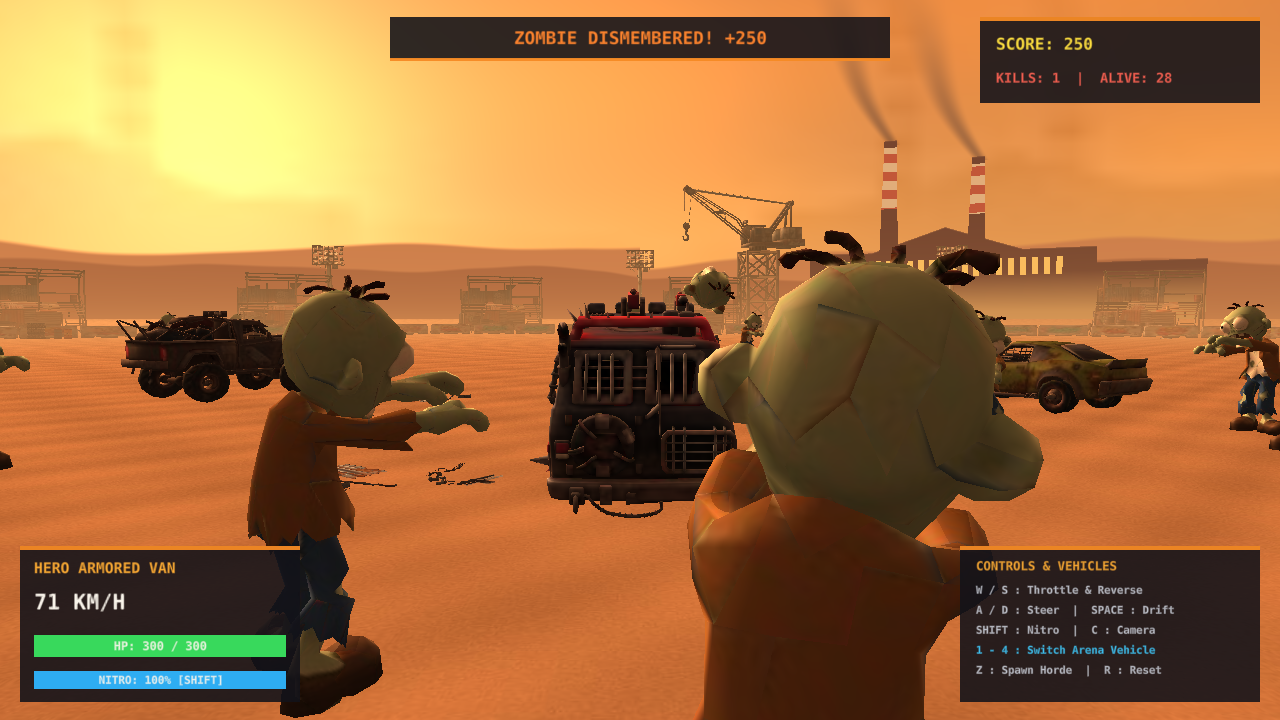
- Don’t Slow Down (4-Slot Clinging):If you lose momentum in a crowd, nearby zombies leap onto four perimeter slots along the sides and rear of your vehicle. They hold on tight and tear at your armor over time until you whip the car into a violent drift or sideswipe a barrier to shake them off!
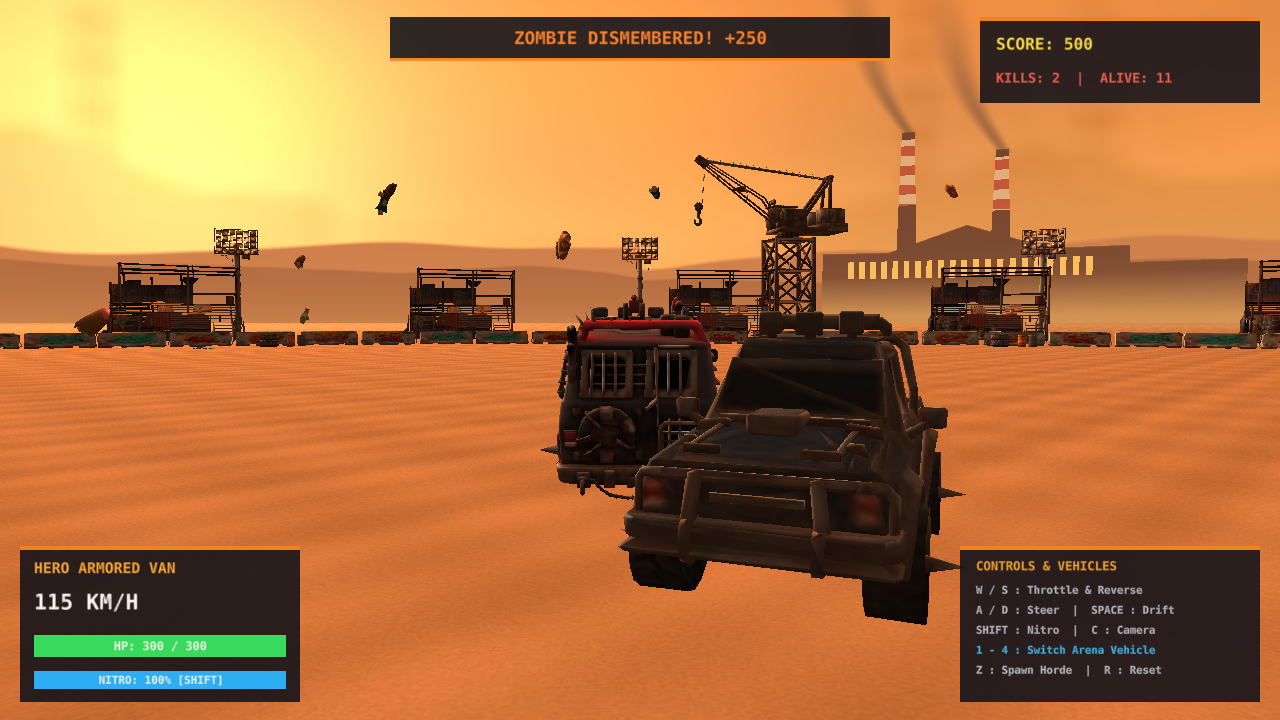
- Explosive 10-Piece Gibs:When you hit a zombie at full speed or with Nitro engaged, the skeletal mesh swaps instantaneously for 10 distinct anatomical pieces (head, torso, arms, legs, hands, and feet) that launch outward along randomized ballistic trajectories and bounce across the sand.
- 98% Texture Footprint Reduction:By resampling the zombie albedo maps down to an ultra-crisp 256×256 palette (just 26 KB!), we kept dozens of animated undead on screen with zero memory spikes.
4. Stunt Ramps, Parabolic Rewards & Heavy Metal Collisions
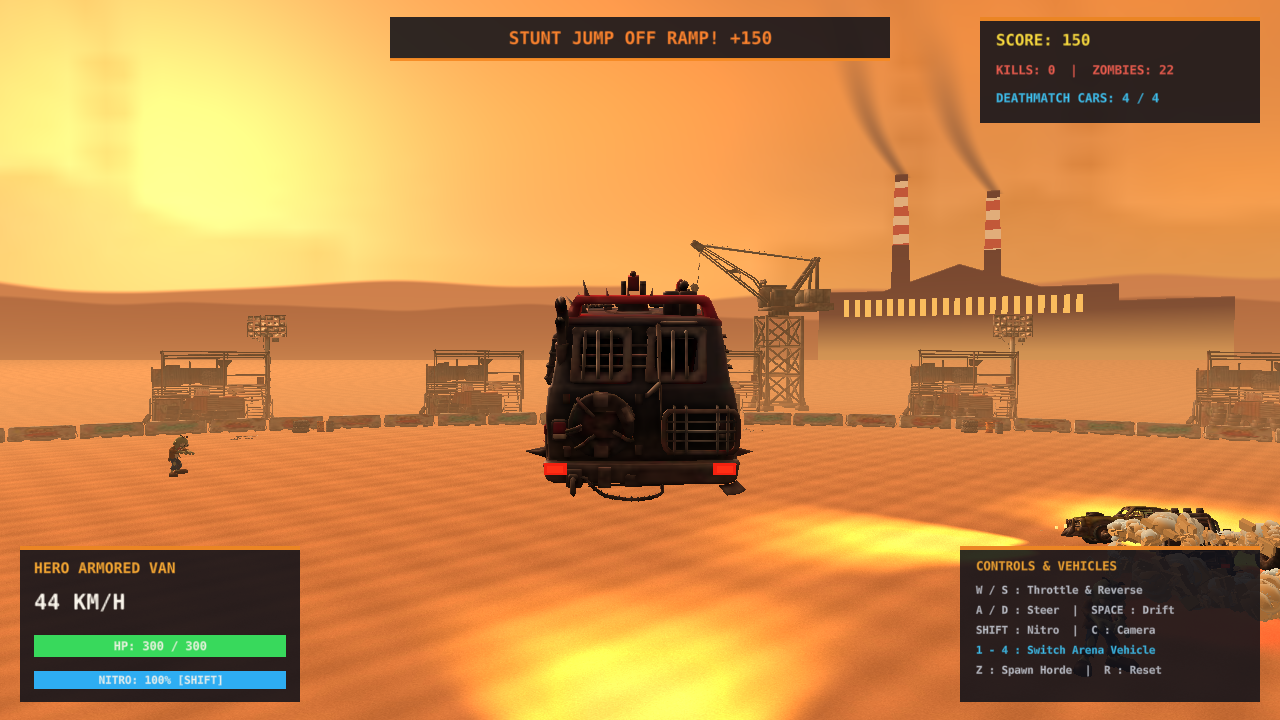
A flat arena can quickly feel repetitive, so we expanded the playable wasteland by35x—enclosing it with over 110 rusted metal barriers, 16 industrial floodlight towers, and grandstands—and added verticality and tactical obstacles:
Calculated Jump Arcs & Mid-Air Pickups
We placed three heavy steel ramps around the arena and mathematically plotted the cars’ parabolic flight curves. Floating right at the 4.4-meter apex of each jump are cyan Nitro crystals, green Repair wrenches, and golden bonus coins that spin and shoot skyward when collected.
Unified Central Scrap Sculpture
To prevent cars from snagging on jagged individual props in the middle of the map, we built a central wasteland sculpture of stacked truck tires, toxic drums, and twisted scrap metal wrapped inside a single unified 4.6-meter elastic collision cylinder—giving players a reliable pivot point for tight drifts and AI ambushes.
5. Under the Hood: Squeezing a 3D Game into 4.88 MB
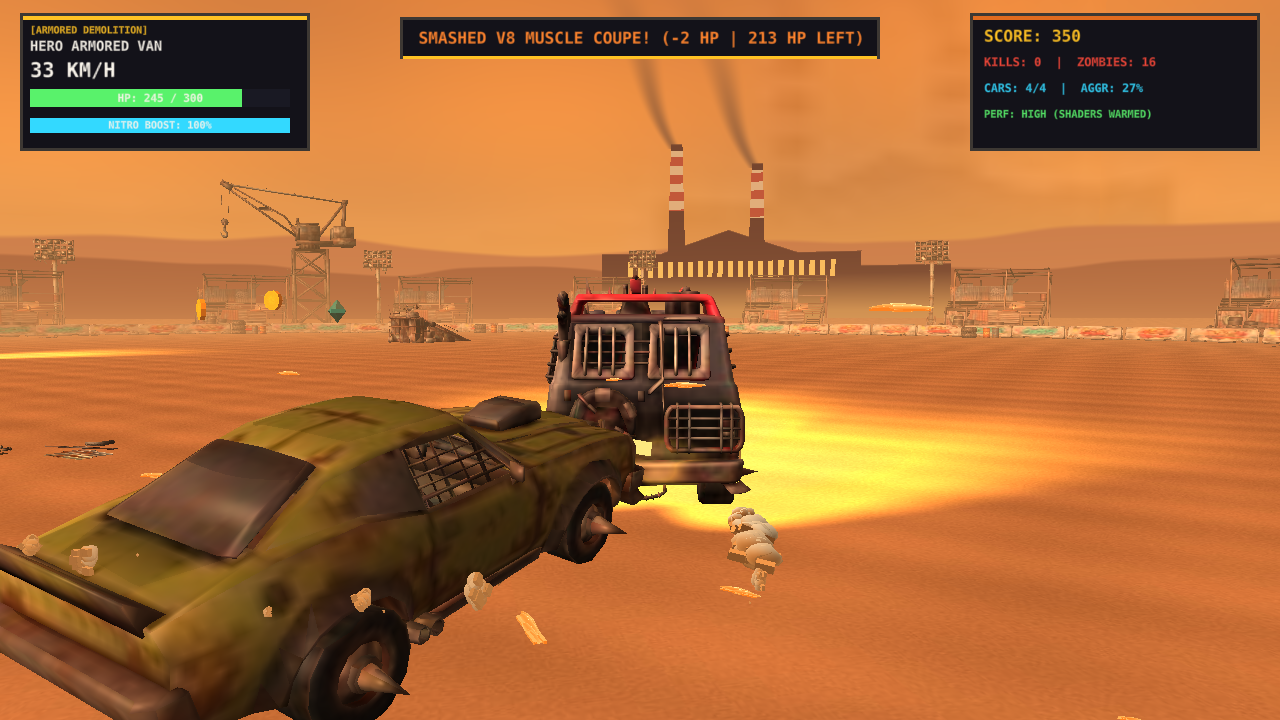
One of the most rewarding parts of this Halloween prototype was the optimization battle. Early playtests revealed a noticeable frame drop whenever a player drove near the outer barrier and looked back across the entire 200-meter arena. Here is how we engineered a rock-solid 60 FPS across desktop and mobile:
- 180° Dynamic Hemisphere Culling:When driving near the perimeter looking inward, a custom vector algorithm disables the far hemisphere of barriers, cranes, and floodlights hidden behind the desert sand fog—instantly saving over 85 draw calls per frame.
- Zombie Distance Sleep:Undead beyond 50 meters freeze their skeletal bone matrix calculations and hide behind the atmospheric haze, waking up seamlessly at 44 meters.
- Staggered AI Launch (+0.75s):Instead of all four cars burning rubber on the exact same frame at “GO!”, rival AI vehicles stagger their launch by 0.75-second intervals, eliminating GPU particle spikes at the start of a match.
- Basis Universal GPU Textures & 300 KB Audio:By compressing textures with hardware-ready UASTC/ETC1S (-60% VRAM usage) and mastering all engine roars, metal crashes, and zombie splats into 24 kHz mono web-tuned samples (shrinking audio from 4.6 MB to under 300 KB), the entire zipped build clocked in at just4.88 MB!
6. Responsive Controls & Prototype Results Summary
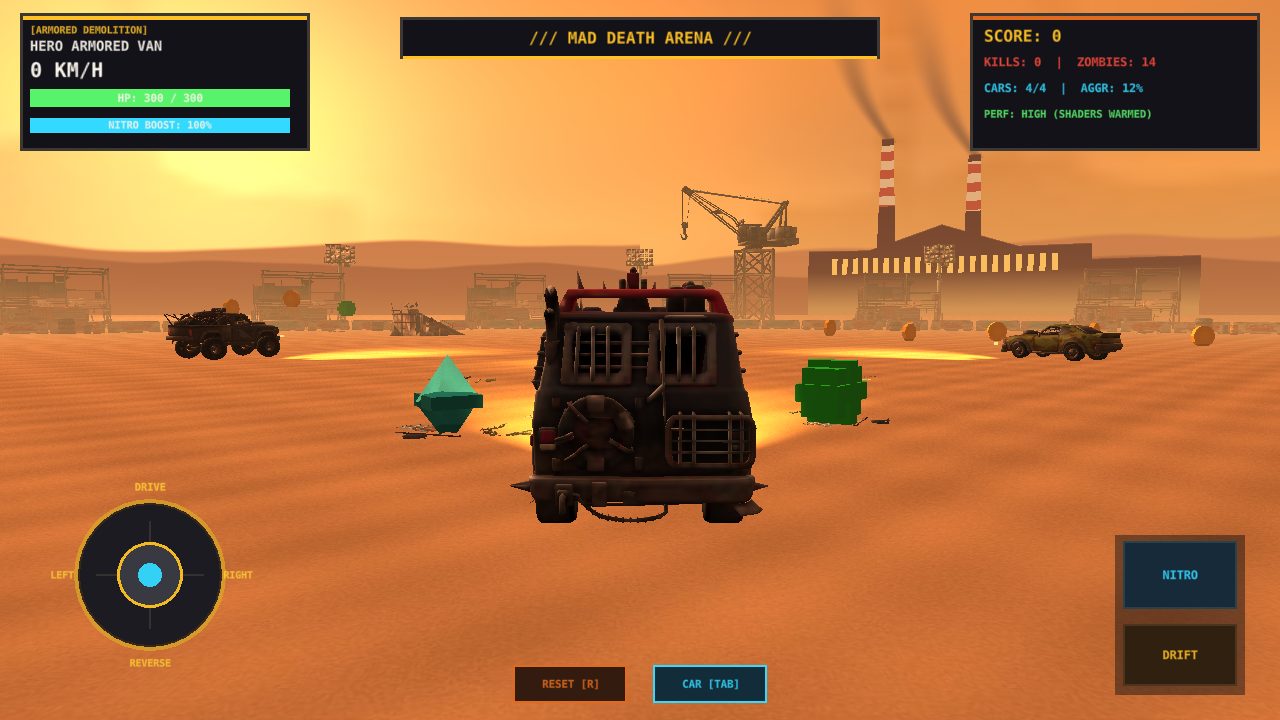
To make sure the prototype felt great on every screen, we built automatic platform detection: desktop players get a 100% clean HUD driven by keyboard controls, while mobile players get a custom proportionalDigital Padwith dynamic top/bottom UI anchors that adapt seamlessly between Landscape and Portrait orientations. You canplay the prototype in your browseron either desktop or mobile to test both control layouts hands-on.
More Games & Prototypes from Rabbit Bay Games
PrototypingMad Death Arenafor Halloween pushed our custom 3D web pipeline further than ever before—from harmonic suspension physics to ultra-compact GPU compression. While you wait for our next update, check out our other behind-the-scenesLava World Adventure Devlog, survive the undead inZombie Fear, or jump straight into browser action in theRabbit Bay Arcade!
Ready to Enter the Arena?
Choose your vehicle, dodge the undead horde, and smash your way through the wasteland. Free to play instantly in your browser!
Which of the four armored rides would you pick to survive the zombie colosseum? Let us know in the comments or on our social channels!
Subscribe to the Newsletter!